Watch any of the elite sides in 2026 and you will spot it within five minutes. Even when they are camped in the opposition half, two or three players never quite join the attack. They sit, they shuffle, they cover the channels. They are doing the most unglamorous and most important job on the pitch: rest defence.
Rest defence is the structure your team holds while you have the ball. It is the safety net that catches a turnover before it becomes a counter-attack. UEFA's technical observers at EURO 2024 singled it out as the defining feature of the best teams in the tournament, and the principle has only become more important since.
What Rest Defence Actually Is
The term comes from the German word "restfeldsicherung", which translates roughly as "spare field coverage". The idea is simple. When you attack, you should always leave a group of players in a balanced shape, ready to deal with the moment you lose the ball. That moment is called the transition, and it is when most goals are conceded at every level of the game.
Most modern positional play sides favour a 3-2 shape behind the ball: three defenders staying high enough to compress the pitch, and two midfielders sitting in front of them to screen counters. Some teams use a 2-3 or even a 4-1 depending on the opponent and the moment in the game. The exact numbers matter less than the principle. You must always have cover behind the ball.
The aim: When possession is lost, your shape is already set up to win the ball back within six seconds or, failing that, to delay the counter and force the opponent into long, hopeful balls.
Why It Matters More Than Ever in 2026
Three forces have made rest defence essential. First, pressing has become universal. Every serious team now hunts the ball aggressively, which means the moment a turnover happens, the game opens up immediately. Second, attacking transitions have got faster. Top sides can be in your box within seven seconds of winning the ball. Third, full backs have become hybrid players who tuck inside or push forward as wingers, which can leave huge gaps in the wide channels if rest defence is sloppy.
The teams that win consistently in this environment are not the ones with the best attackers. They are the ones whose shape behind the ball is always organised, even when their forwards are creating chaos in the final third.
How to Build Rest Defence Into Your Team
You cannot just tell players to "stay back". They need a framework, and they need to rehearse it until it is automatic. Here is a three-step approach you can use this week.
Step One: Define your shape. Decide whether you want 3-2, 2-3, or another structure when you have the ball in the opposition half. The simplest place to start with most teams is a 3-2 with both centre backs and the deepest midfielder forming the back triangle, and the two number sixes screening in front.
Step Two: Identify the trigger moments. Rest defenders need to know when to step up, when to hold, and when to drop. The basic rule: if the ball is being played wide and forward, step up to compress space. If the ball is being played centrally and your team is committed forward, hold and screen. If a turnover is about to happen, drop into delay mode.
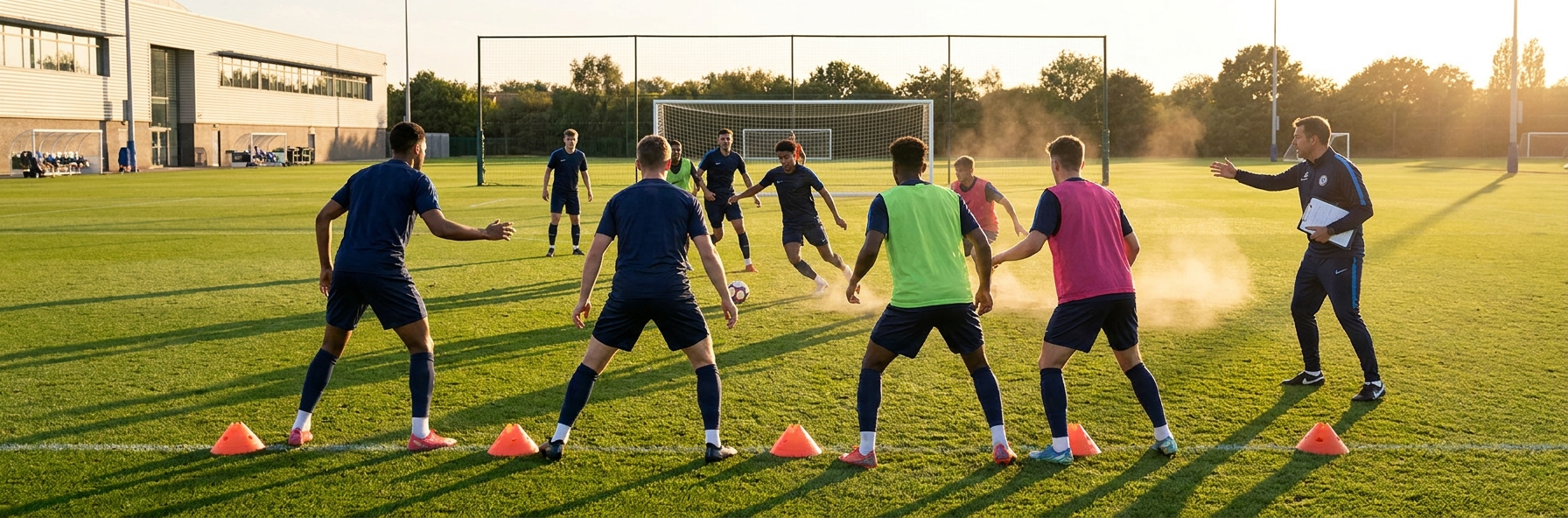
Step Three: Rehearse turnovers, not just attacks. Most training sessions practise what to do with the ball. Rest defence training flips this on its head. Set up an attacking pattern, then have a coach blow a whistle at random to simulate losing the ball. The rest defenders must immediately switch on and react.
Common Mistakes Coaches Make
The biggest mistake is treating rest defence as a punishment for defenders. If your centre backs see staying back as boring, they will drift forward and leave gaps. Sell it as the most important attacking job in the team: without their cover, the rest of the side cannot commit forward with confidence.
The second mistake is rigid positioning. Rest defence is not about standing still on a chalk mark. It is about reading the game and adjusting. A good rest defender slides ten yards left when the ball moves left, drops five yards deeper when the attack overloads centrally, and steps up to compress when the ball goes wide.
The third mistake is forgetting the midfield screen. Your two screening midfielders are the difference between a turnover that becomes a recovered ball and a turnover that becomes a goal. They must be aggressive, mobile, and tactically intelligent. This is the modern number six role, and it is the most undervalued position on the pitch.
Key Coaching Points
- Always have at least four players behind the ball when attacking in the opposition half
- Centre backs should stay connected, never more than fifteen yards apart laterally
- Screening midfielders should be on the same line, not stacked, to cover the central channel
- Communicate constantly: rest defenders should be talking to each other every few seconds
- Rehearse the moment of transition more than the act of attacking itself
- Use video to show players where they should be at the moment of turnover, not just after it
 sportplan_football