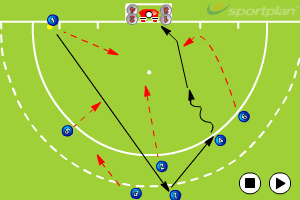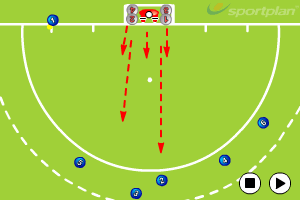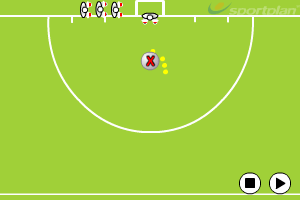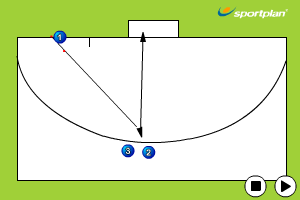
Penalty corners account for roughly one third of all goals in hockey. At elite level, teams that convert corners consistently win tournaments. Yet many club teams still rely on a single routine - the straight drag flick - and wonder why their conversion rate is poor.
The best corner units have multiple variations that look identical in the set-up but produce completely different outcomes. They read the defence, communicate mid-routine, and adapt in real-time. Here's how to build that capability.
Why Variations Matter
If you only have one corner routine, defenders know exactly what's coming. They can position optimally, time their run perfectly, and nullify your threat. Variations force them to defend with uncertainty, which slows their reactions and creates opportunities.
Even the threat of variations is valuable. A defence that fears your slip pass must cover that option, potentially leaving the flicker with more space. A defence that respects your deflection option can't commit fully to rushing the flicker.
Building Your Corner Repertoire
The Straight Flick
Still the foundation of most corner attacks. The injector delivers to the stopper, the stopper controls, the flicker executes. Execution is everything - practice until the movement is automatic.
The Slip Pass
Instead of shooting, the flicker slips the ball square for a teammate arriving at pace. This works best when the defence is rushing hard at the flicker, leaving space for the second shooter. The slip must be disguised - the flicker's body position should look identical to the shooting action until the last moment.
The Reverse Stick Deflection
A player positioned at the near post redirects the injection or a first-phase shot. Requires excellent timing and soft hands. The key is the deflector reading the line of the ball and adjusting their stick angle accordingly.
The Switch
The ball goes to a different stopping position, changing the angle of attack entirely. This can catch defenders who are running at the expected location. The switch must be called early so all players adjust their positions.
The Second Phase
Designed to score from the rebound or second ball. Requires players positioned to follow up, clear communication about who's doing what, and the discipline not to crash in too early and obstruct the first shot.
Adaptive Decision-Making
The best corner units don't just execute set plays - they read and adapt. The stopper or flicker might call an audible based on what they see in the defence. This requires:
Pre-agreed signals: Simple calls that the whole unit understands. "One" might mean straight flick, "Two" might mean slip. Keep it simple under pressure.
Shared understanding: Every player must know every routine so they can adjust instantly when the call comes.
Practice under variation: Train corners where the routine is decided only after the injection is released. This builds the adaptability you need in matches.
Execution Excellence
Variations only work if the fundamentals are perfect. Focus relentlessly on:
The injection: Speed, accuracy, height. A poor injection kills every routine. Practice hundreds of injections until they're automatic.
The stop: Clean, still, in the right position. A moving ball or a ball that's stopped in the wrong spot takes time to adjust for.
Movement timing: Everyone moves at the right moment. Too early and you're offside or obstructing. Too late and the opportunity is gone.
Training Structure
Week 1-2: Master the fundamentals. Injection, stop, straight flick. Hundreds of repetitions until it's automatic.
Week 3-4: Add your first variation. Practice until it's as smooth as the straight flick.
Week 5-6: Add a second variation. Begin mixing routines randomly in training.
Ongoing: Introduce adaptive elements. Practice reading the defence and calling audibles. Add new variations as your unit's competence grows.
The Mental Game
Corner pressure is intense. The whole stadium is watching, the defence is rushing at you, and you have fractions of a second to execute. Mental preparation matters as much as technical preparation.
Develop pre-corner routines that calm the mind and focus attention. The same deep breath, the same visualisation, the same trigger word. Consistency breeds confidence.
After missed corners, reset immediately. The next one is what matters. Dwelling on failures creates tension that disrupts technique.
Key Coaching Points
- Master fundamentals before adding variations
- Build a repertoire that keeps defences uncertain
- Practice adaptive decision-making
- Execution quality is non-negotiable
- Develop mental routines for corner pressure