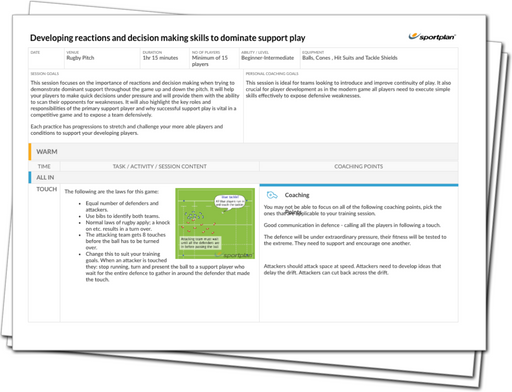
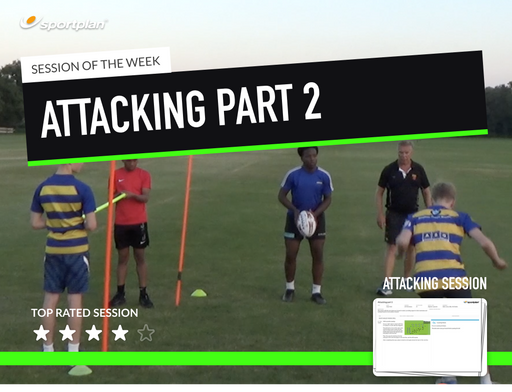
In order to shore up your side's defence and to help them when they're on the sharp end of the overload this week's session is designed to introduce your team to the Drift Defence.
Although it's not perfect the drift defence is a great technique for when you have fewer defensive players in the line than the opposition has attackers. An example would be when the attack has four players in attack and, you only have three defenders. The drift will give your players a strategy for defending in these overload situations.
What's in the session?
To ensure your players arrive early and know what their role is in the drift defence this session kicks off with a game of All in Touch to set up the goal for this session - to create a drift defence! We then take your players out of the game to develop their drifting, through 4 small-group practices, each progressively increasing in difficulty.
Now everyone is drifting like a pro it's time to reward your players and put it back into a game situation. That's why we finish with a conditioned game - allowing your players to put practice into play!

in more ways than one
 sportplan_netball



in more ways than one
sportplan_rugby

Tacklers are aiming lower, so carriers who dip late put heads at risk. Teach footwork, a strong early body height and leg drive to win the collision safely.

The hooker's brake foot moved from trial into full law in July 2026. Here is how to coach it so your front row stays stable, legal and safe.

Your players can pass beautifully in a warm-up grid. Then a defender closes, their lungs are burning, and the ball goes to ground. Here is how to build catch-pass skills that hold up when it matters.