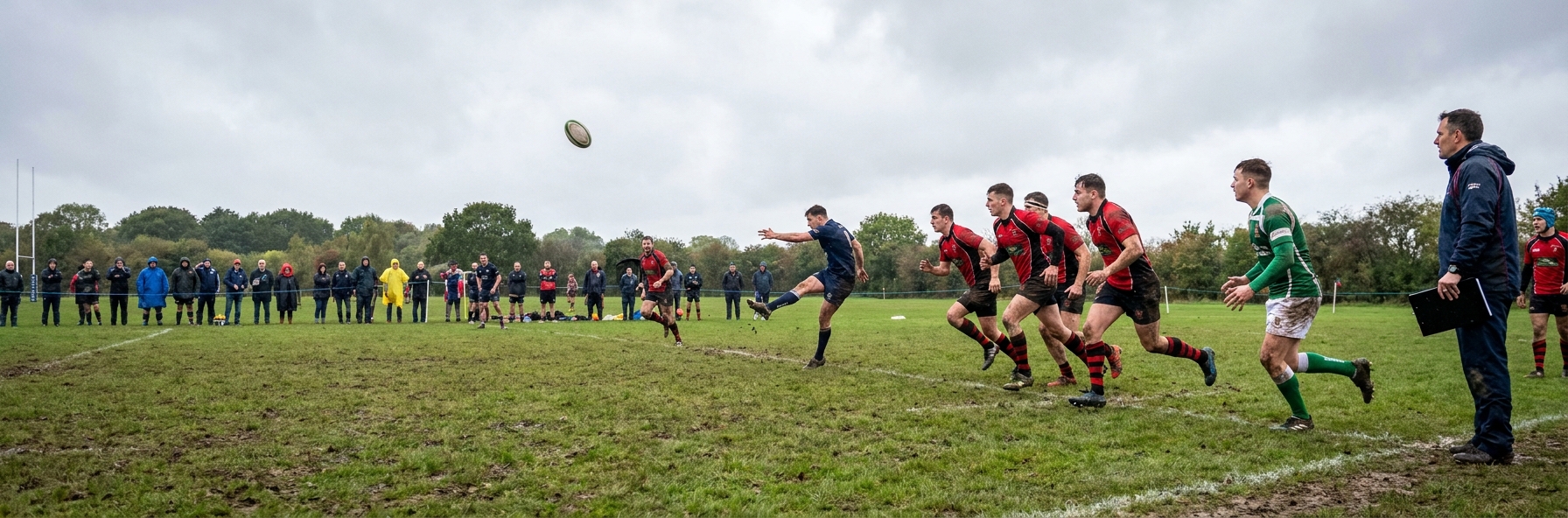
At community level, the contestable kick often gets a bad name. Too many box kicks go too long, the chasers arrive in ones and twos, and the opposition catch it unchallenged and run it back. That is not a kicking problem. It is a chase problem.
A good contestable kick is a way of winning the ball back or putting a catcher under real pressure. It needs a kick with enough hang time, a chase that arrives together, and players who know how to compete safely and legally when they get there. The same habits make your own back three far more secure under the high ball.
What Makes a Kick Contestable
Height and distance have to match. The ball needs to hang long enough for your chasers to get underneath it, and land in an area where they can realistically arrive at the same time. A kick that goes miles downfield with no hang time is a gift to the receiver, however good it looks.
Kickers should agree a target with the chasers before the ball is kicked. A scrum-half box kicking from a ruck and a fly-half putting up a bomb from hand need slightly different chase organisation, but the principle is the same: everyone knows where it is going.
A Four-Step Framework
Step One: The kick and the call. Use a clear, simple call so chasers know a kick is coming and roughly where. Kickers practise hang time over distance, not just length.
Step Two: The chase line. One player chases the ball to contest, while the others fan out in an organised line either side, ready to tackle the receiver or pounce on a loose ball. Chasers must be onside, so players ahead of the kicker work back and do not charge forward until they are put onside.
Step Three: The contest in the air. The chaser competing for the ball should be looking at the ball, arriving in time to jump for it, and genuinely trying to catch it. Under World Rugby Law 9.17, a player must not tackle, charge, pull, push or grasp an opponent whose feet are off the ground. If the chaser is late, they hold back and tackle once the receiver lands.
Step Four: After the ball comes down. If you win it, support players are already arriving to keep it alive. If the receiver catches it, the chase line tackles low and quickly. If it goes loose, the nearest chasers secure it while the rest hold their width.
The Receiver's Side
Your own back three need the mirror image of all this. Call early and loudly, get into line with the ball, and attack the catch rather than waiting for it to drop. Keep eyes on the ball, reach up with both hands to take it at its highest point, and bring it securely into the body.
Team-mates should get close enough to support the catcher once they land, but not block chasers. World Rugby Law 9.15 says a player not in possession must not hold, push, charge or obstruct an opponent not in possession, so supporting players need to stay out of the chaser's path and be ready to help once the ball is caught.
How to Train It
Start without contest. A kicker or coach feeds high balls and catchers work on calling, positioning and securing the catch. Add a passive chaser with a pad, then a player who genuinely competes, always with the same rule: if you cannot reach the ball, do not touch a player in the air.
Then put it into a game. Have a scrum-half box kick from a ruck, with a full chase line against a small receiving group. Score points for regaining the ball, for tackling the receiver behind the point where they caught it, and for a clean, supported catch by the receivers.
Key Coaching Points
- Match hang time to distance so chasers can realistically arrive with the ball.
- Chasers must be onside; players in front of the kicker work back before chasing.
- One player contests the ball, the rest hold a connected chase line either side.
- Never tackle, charge, pull, push or grasp a player whose feet are off the ground.
- Receivers call early, attack the catch at its highest point and secure the ball.
- Support the catcher, but never run into or block an opponent chasing the kick.
Recommended Drills



Frequently Asked Questions
Is it safe for younger players to compete for high balls?
Build it up gradually. Start with uncontested catching, then add passive pressure, and only introduce a genuine aerial contest once players can catch confidently and understand they must not touch a player in the air. Always check the RFU age grade regulations for your age group before introducing kicking and contests into games.
How many players should chase a box kick?
There is no fixed number, but you need someone contesting the ball and enough players either side to cover a knock-back or a run from the receiver. Most important is that chasers arrive together in a line rather than strung out one behind another.
Our chasers keep getting penalised for being offside. What are we doing wrong?
Usually players are in front of the kicker and chase straight away. A player in front of a team-mate who kicked the ball is offside and has to work back or be put onside before taking part. Coach your forwards around the ruck to turn and retreat first, and let onside players lead the chase.

 sportplan_rugby