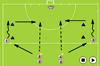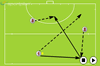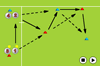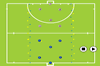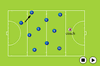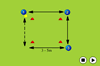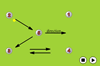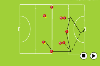
Field Hockey: pass run out

August 2026

New rule guidance lands every season and most of it never touches a Saturday. This year is a little different. England Hockey's guidance for 2026/27, following the latest revisions to the FIH Rules of Hockey, includes a change that has been running as a trial and is now permanent, plus a handful of clarifications that will catch out any squad that has not been told about them.

The changes apply from 1 September and cover both adult and junior competitions. Some leagues and clubs choose to adopt them early in pre-season friendlies, which is a sensible way to get everyone familiar before the points start counting.

The Aerial Ball Rule Becomes Permanent

The headline change is that the aerial ball rule has been permanently adopted across all England Hockey competitions. Under it, a defender may approach once the receiver has touched the ball, rather than having to wait until the receiver has controlled it and brought it to the ground, provided the initial five metres of safe space were respected.

That sounds like a small distinction and it is not. The window in which a receiver is protected is now shorter, and the moment the contest becomes live is earlier and easier for umpires to see. Receivers who were used to taking a comfortable extra second to settle the ball will find an opponent arriving sooner than they expect.

Penalty Corner Equipment and the Yellow Card

There is revised guidance on the disposal of penalty corner protective equipment. If a person is hit on or above the knee in a normal stance by discarded equipment, the player who threw it receives a yellow card.

This is worth ten minutes of your pre-season time, because it is a purely behavioural change. Defenders coming out of a corner have historically flung masks and gloves aside without much thought. Teach the squad to place equipment down and to the side rather than throwing it, and you will never have to think about the rule again.

Goalkeeper Equipment and Other Clarifications

The maximum permitted size of a goalkeeper's left-hand protector has increased to 365mm, which allows manufacturers to produce larger gloves that remain legal under FIH regulations. If your keeper is due new kit, this is useful to know before they buy.

Alongside these, the guidance includes clearer sanctions for having too many players on the pitch, and further clarifications for goalkeepers and umpires. None of these should change how you play, but a squad that knows about them is a squad that does not argue with the umpire in week one.

How to Brief Your Squad

Step One: Cover it once, properly, in a pre-season session rather than drip-feeding it. Ten focused minutes with everyone present beats five separate conversations.

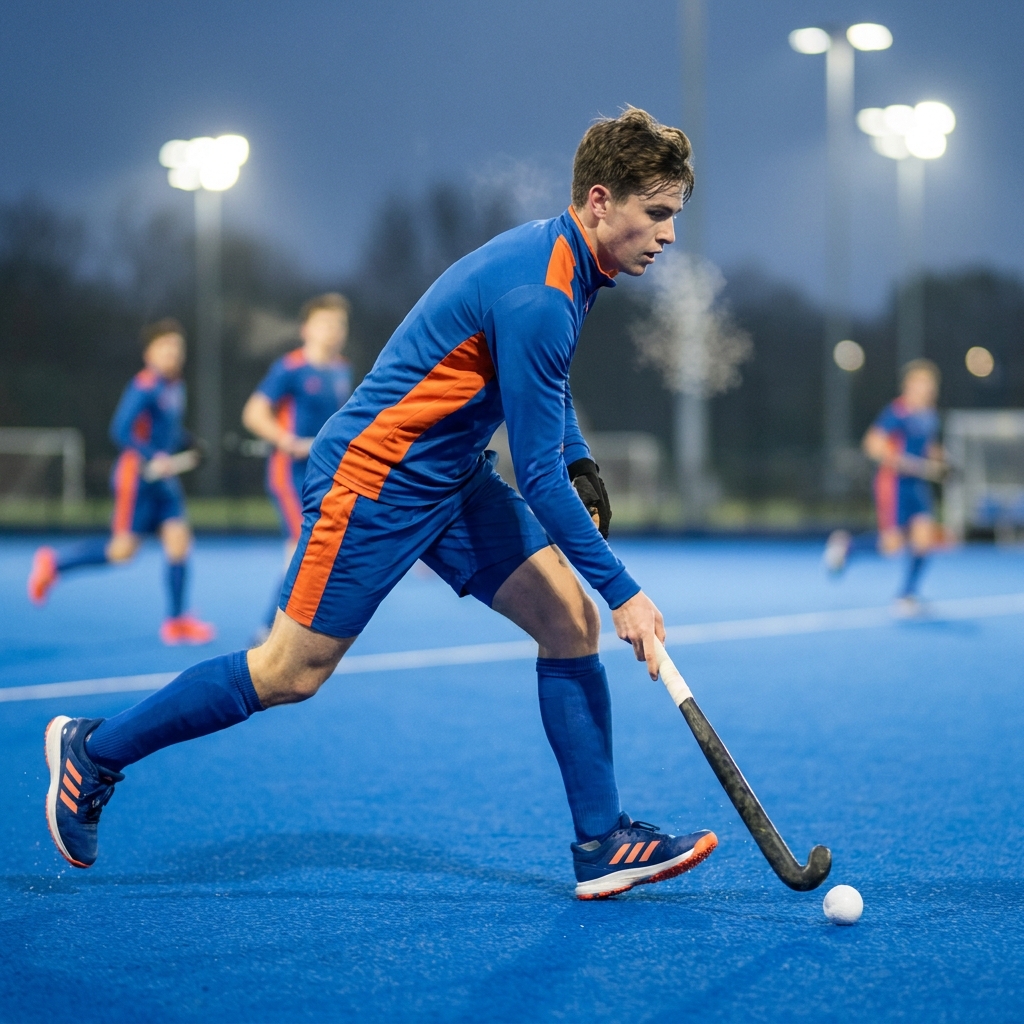
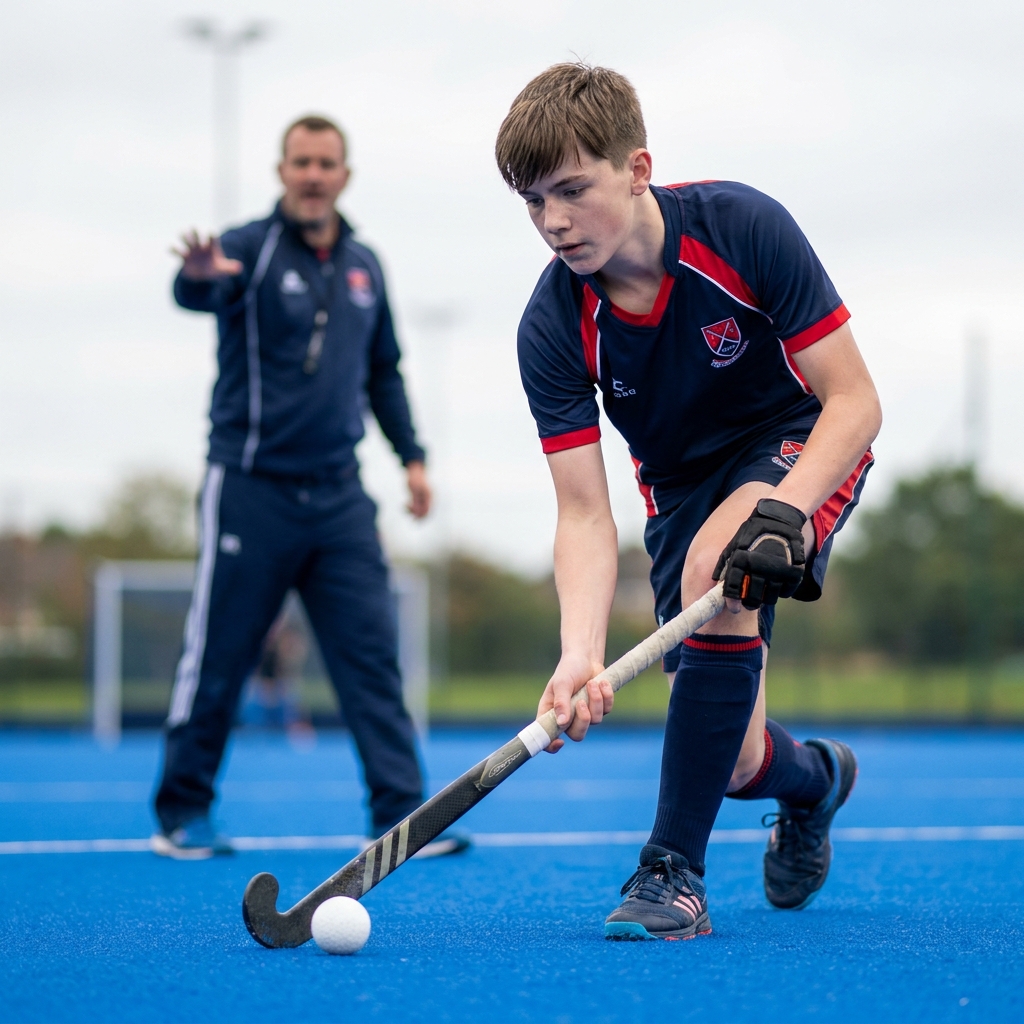
Step Two: Coach the aerial change with the ball, not the whiteboard. Set up receipts under a falling ball with an approaching defender and let players feel how much less time they have.

Step Three: Rehearse the equipment habit at your first penalty corner practice, so placing kit down becomes automatic before anyone is under pressure.

Step Four: Tell your umpires and your captains what you have briefed. A captain who understands the change is far more useful than one who reacts to it.

Step Five: Use any early-adopting pre-season fixtures as live rehearsal, and review what actually happened rather than what you expected.

Key Coaching Points

  • The aerial rule is now permanent: defenders may approach once the receiver has touched the ball.
  • The five metres of initial safe space still has to be respected before any approach.
  • Receivers have less settling time, so first touch under a falling ball matters more than ever.
  • Place penalty corner equipment down and to the side; throwing it can now earn a yellow card.
  • Goalkeeper left-hand protectors may now be up to 365mm, useful before buying new kit.
  • Brief the whole squad once in pre-season rather than correcting individuals in September.

Recommended Drills

VIEW ALL PASSING DRILLS

Frequently Asked Questions

When exactly do the 2026/27 rules apply?

From 1 September 2026, across both adult and junior competitions. Leagues, clubs and organisers may adopt them earlier in pre-season or summer competitions, which many do specifically to help everyone get familiar before the league campaign starts.

Does the aerial change mean the five metre rule has gone?

No. The initial five metres of safe space still has to be respected. What has changed is when a defender may approach after that: once the receiver has touched the ball, rather than once they have controlled it and brought it to the ground.

Do I need to change how we train aerials?

Only in emphasis. Spend more time on a clean, decisive first touch under a falling ball and on what the receiver does immediately afterwards, because the contest now arrives sooner. The receiving technique itself is unchanged.

pass run out DRILLS
View All
Unfortunately there were no results for your search! Please try again
pass run out ANSWERS
View All

how do i stop my defenders form panicking when they have possession in there own circle

Ask a question and have it answered by Coaches from around the world and Sportplan's team of Experts.

luke connolly Coach, Ireland

what are good penalty corner plays?

what are good penalty corner plays?

Archived User Coach

Can some explain the Steal the Bacon drill?

Can some explain how the Steal the Bacon drill works. I don't see it in the list of drills

Archived User Coach

My team are constantly allowing oppositions to score?

My team are constantly allowing oppositions to score from penalty corners we do 1st runner 2nd runner amp; 2 players on the post, what can I do.

Leanne Johnston Coach, Ireland

Right-Wing Position

My daughter plays U13 hockey in the position of right wing.She gets different advice from her school coach and her club coach.I want to make sure that she is getting the right advice as she is passionate about her hockey. Firstly, exactly what is the full function of a right wing at this level of hockey (she will be going to U15 club hockey and U14 school hockey next season) She has a good understanding of the game and appears to me to read it well (I only played school level many years ago and things change) When her team is in the offensive position in the “D” she mostly waits at goal post to deflect ball into goal.  She appears to not be involved.  Comments from spectators have been made as to why she just stands there. There is a very skilled player in her team who hits the ball EXTREMELY hard.  I believe that at this level of hockey these extremely hard hits/passes do not achieve anything, they just keep going out. However, please can you advise on how to stop and control these very hard passes (that is if one can get to them) in order to move on with the game. Lastly, can you send some drills/exercises to get her eye in as well as positioning her body correctly for goal shooting.  The “hard hitter” and my daughter seem to be the main goal shooters of the team. Many thanks Lynne

Archived User Coach

Re involving GKs in junior coaching sessions.

I really struggle to make practice fun and useful for the GKs. My attention is naturally focussed on the outfield players, meaning most of the time I simply have drills finishing with a shot on goal to keep the GK involved. Pretty boring for them. Any ideas how I can involve them more? Thanks, Charlie

Carol Ridge Coach, England

Looking for a 6-a good side hockey formation?

I am looking for 6 a side hockey formations. We have been playing 3-1-1-1. Worked very well, however sweeper was so good, goalie never touched the ball. I want to move sweeper to goalie/ sweeper but our mid field player is too good to just play right. What to do? 2-2-1-1 or 1-3-1-1?     

Archived User Coach

How to encourage positional play (spreading out) to U9 players?

How do you encourage positional play and spreading out on hockey field U9 girls level?

Archived User Coach

How to get ball carriers to pass?

I have a team of 14 year old girls who mostly want to run with the ball rather than pass. A lot of them are strong ball carriers and so often achieve success this way but am concerned that this strategy will not work once the other teams get bigger and stronger, and that it is too one dimensional. What are the best ways to change this approach?

Archived User Coach

new indoor 5 v 5 format?

Does any one have any ideas on structure for the new 5 v 5 indoor format?

Lisa Nay Coach, Australia

Level 2 Practical Assessment - Help needed!

Hi all,I've got my level 2 assessment coming up on Sunday and I just wanted to quickly check whether there's a 'recommended' structure to the session plan.Btw, this is a level 2 practical assessment and is with juniors (U14s).One coach has suggested a 3 part approach:1) techniques and skills required2) unopposed 3) opposedThe theme I'm choosing, which is a bit of a generic one, is defending in a channel (as I'm a defender and it's pretty straight forward).I'm not really looking for info on what exactly to include (i.e. theme specific) but rather general structure or whether E.H. have an approved structure to sessions?My session's on Sunday, so a quick reply would be awesome.Thanks,Gary

Gary Thompson Coach, England

Hockey level 2 assessment

Hi,I need to play 4 linked hockey sessions to a specific theme I don't know which one to chose such as I can't say attack because there can be so much to cover . So any help?

Tajinder Kaur Sahota Coach, United Kingdom

How do you teach children aged 7 how to play a hockey match?

I coach aged 7 children and I don't know how to teach them how to play a proper hockey match without all of them going for the ball and not staying in their positions. Do I put lines where they are not allowed to pass? or what?

Bev Coach, South Africa

How to coach school team with novices and experienced players?

Hi,I perhaps naively, expected to have most of our team from last year carry over and only have a few new comers to integrate and get up to speed with the rest. However meeting the team at our first practice last night i find I have five players still at school from last year and the rest all new comers, most of whom had not held a hockey stick at all till practice.This being only my second season coaching (year 9 to year 13 boys) has left me feeling a little blindsided, and feeling quite unsure how to prepare practices that target both groups of boys. Do i lump them both groups together, keep them separate? What drills/exercises to best bring the new comers up to speed.I don't want to neglect either group, keep practice worthwhile for the experienced boys, but also bringing the new comers up to a level were they can mix in with the others and learn organically from them while practicing as a team. David

David Smith Coach, New Zealand

teaching presses on free hits and 16s

Hi allI am looking for advice on how to implement processes in my girls school hockey team. processes of setting up presses, defensive structures and counter attacking thinking. I have 14 players in the team from 15 years old to 18. we train twice a week. only a few play club hockey as well. We either play a 3-1-4-2 or a 3-1-3-3.I find it difficult for example, when you want to teach a press on the opposition 16, to simulate gameplay with only 14 players (if they are all at training). I can have my halves setup for taking the 16 and then get my strikers and links to setup, but then I still want defenders to see things from the back but they are taking the 16? Also when taking the 16 they then don't have any support in the drill because everyone else is setting up a press?I know we need to work on our basics in order for the other tactics and skills and game plans to work. However I find it frustrating with this team that on counter attacks for a few reasons which I am struggling to mend;- they only head forward. No one holds up the ball to wait for support.- they run straight and don't use angles- they pass too late and get tackled - they don't have the vision to see an early pass or pass into space- players without the ball do not run into useful positions and angles and get caught out by the person with the ball who then makes a pass to no one and it runs out of play.So suggestions please for;- open, creative but simple counter attacking- teaching processes for presses on free hits and 16s- coaching how to take 16s and work your way out- coaching vision and expecting your players to be in support. RegardsMatt

Matthew Lydall Coach, South Africa

Defence

how to play defending 3V2

Lakhindra Pahan Coach, United Kingdom

teaching presses on free hits ...

Hi allI am looking for advice on how to implement processes in my girls school hockey team. processes of setting up presses, defensive structures and counter attacking thinking. I have 14 players in the team from 15 years old to 18. we train twice a week. only a few play club hockey as well. We either play a 3-1-4-2 or a 3-1-3-3.I find it difficult for example, when you want to teach a press on the opposition 16, to simulate gameplay with only 14 players (if they are all at training). I can have my halves setup for taking the 16 and then get my strikers and links to setup, but then I still want defenders to see things from the back but they are taking the 16? Also when taking the 16 they then don't have any support in the drill because everyone else is setting up a press?I know we need to work on our basics in order for the other tactics and skills and game plans to work. However I find it frustrating with this team that on counter attacks for a few reasons which I am struggling to mend;- they only head forward. No one holds up the ball to wait for support.- they run straight and don't use angles- they pass too late and get tackled - they don't have the vision to see an early pass or pass into space- players without the ball do not run into useful positions and angles and get caught out by the person with the ball who then makes a pass to no one and it runs out of play.So suggestions please for;- open, creative but simple counter attacking- teaching processes for presses on free hits and 16s- coaching how to take 16s and work your way out- coaching vision and expecting your players to be in support. RegardsMatt

Matthew Lydall Coach, South Africa

What is the best drill for tea...

My team have asked for drills to help them at 16s, can anyone help me

Jax Pheiffer Coach, England

JOIN SPORTPLAN FOR FREE

  • search our library of 1000+ hockey drills
  • create your own professional coaching plans
  • or access our tried and tested plans

Sportplan App

Give it a try - it's better in the app

YOUR SESSION IS STARTING SOON... Join the worlds largest hockey coaching resource for 1000+ drills and pro tools to make coaching easy.
LET'S DO IT