Field Hockey: pre season fitness

September 2026

September is when club hockey changes shape. Juniors step up into the lower adult teams, returning players dust off their sticks and new members turn up having not played since school. For a captain or coach, those first few Saturdays are some of the most important of the whole season.

Get it right and you gain players who will be in your first team in three years' time. Get it wrong, and a nervous fifteen-year-old who spent the game chasing shadows quietly stops coming. The difference is rarely about talent. It is about how well the team welcomes them.

What New Players Are Actually Worried About

Most juniors are not worried about skill. They are worried about the pace, the physicality, getting shouted at and letting the team down. New adult players often share the same fears, plus the awkwardness of not knowing anyone.

Safety comes first. Make sure every junior has a mouthguard and shin pads, and that your club's welfare officer and captains know the current England Hockey regulations and club policy on juniors playing adult matches. Once the basics are covered, confidence becomes the thing you are really coaching.

A Five-Step Framework for the First Month

Step One: Give them one clear job. "Play left half" is not a job. "Stay goal-side of their right forward and give the ball to our centre-back when you win it" is. A single, simple responsibility lets a new player contribute without needing to understand the whole system on day one.

Step Two: Pair them with a buddy. Pick an experienced, calm player who plays near them on the pitch. The buddy talks them through restarts, reminds them of their job and is the first voice of encouragement after a mistake.

Step Three: Keep team principles short. Three is plenty: get goal-side when we lose the ball, give an option when we have it, and talk. Adults benefit from this as much as juniors, and it stops mixed-experience teams pulling in different directions.

Step Four: Manage minutes deliberately. Use rolling substitutions to give newcomers short, regular spells rather than one long, exhausting block. Try to bring them on at calmer moments, not in the last five minutes of a tight game while defending a penalty corner.

Step Five: Talk to parents early. A quick message before the first match explaining who the captain is, what position their child might play and how substitutions work removes a lot of anxiety on the sideline. Keep feedback to parents positive and specific.

How to Train It

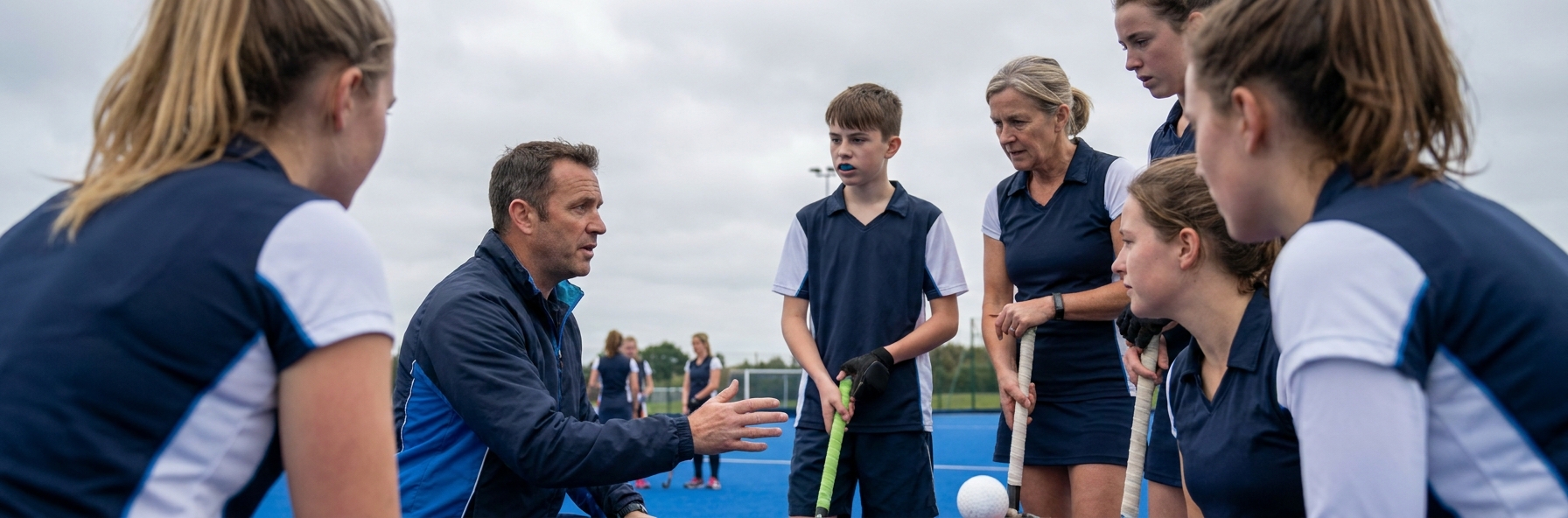
If your club trains mixed groups midweek, use small-sided games where juniors and adults play together in the same units they will play in on Saturday. A newcomer who has practised tracking back alongside their buddy on Tuesday will do it far more naturally at the weekend.

Build in short positional sessions too. Walk through where a defender or midfielder stands when the ball is in different areas, then play it at half pace before adding full pressure. Understanding where to be is the fastest route to confidence.

Key Coaching Points

  • Check kit, mouthguards and club policy before anything else; safety is not negotiable.
  • Give each new player one specific, achievable job rather than a position name.
  • Buddy them with a calm, experienced teammate who plays nearby on the pitch.
  • Keep team principles to three simple, repeatable ideas everyone can follow.
  • Use short, regular substitution spells and choose calmer moments to bring newcomers on.
  • Praise effort and good decisions loudly, and keep corrections quiet and private.

Recommended Drills
VIEW ALL ROLES AND RESPONSIBILITIES DRILLS

Frequently Asked Questions

Where should I play a junior in their first adult match?

Somewhere with clear reference points and support around them. A wide midfield or wing role with a buddy close by often works well, as the job is easy to explain. Avoid putting a nervous newcomer at centre-back, where one mistake is very visible and very costly.

How do I stop experienced players shouting at newcomers?

Set the standard before the first game. Tell the team that instructions are welcome but criticism is not, and that the captain handles any corrections. If one player keeps doing it, have a quiet word afterwards. The culture of a lower team is set by its senior players.

Should juniors get the same minutes as adults?

Not necessarily the same, but they should get meaningful time every week. Short, regular spells are better than a full game one week and ten minutes the next. Consistency helps them settle, and it shows them they are a real part of the team.
Unfortunately there were no results for your search! Please try again
pre season fitness ANSWERS
View All

What's your favourite field hockey drill?

What's your favourite field hockey drill?

Sportplan Team Coach, United Kingdom

Does anyone have a link to a few GOOD Hockey Specific fitness tests?

Does anyone have a link to a few GOOD Hockey Specific fitness tests. And I'm not looking for bleep tests which is somewhat out of date. Many thanks

Grant Hunt Coach, United Kingdom

What is a good fitness programme for hockey?

What is a good fitness programme for hockey?

Archived User Coach

Has anyone got a pre-season fitness plan for a ladies?

Has anyone got a pre-season fitness plan for a ladies hockey team?

Archived User Coach

pre season training for ladies hockey team?

With pre season looming can you give any advice as to the best training method for ladies hockey team

David Reid Coach, Northern Ireland

is there more on goalkeepers

i'm a goalkeeper and need some more tips

Florence Coach, Scotland

need training plan for 3 months

I want a training plan for preparation my team for the tournament after 3 months

Manish Bhatt Coach, United Kingdom

Identify skills

I want to use a training circuit with various stations that's sole purpose is to test if their strengths lie in attacking or defending. Pre-season training before hockey trials.

Charlene Bester Coach, South Africa

pre season training for ladies...

With pre season looming can you give any advice as to the best training method for ladies hockey team

David Reid Coach, Northern Ireland

AFL training types and methods...

Hello, can someone please help with this question: Describe two different training types and methods which would have a positive impact on sports performance for AFL players. I need to provide 2 training methods for the 2 training types where the training methods include (examples are the training methods): Aerobic-eg continuous, fartlek, aerobic interval and circuit. Anaerobic- eg anaerobic interval. Flexibility-eg static, ballistic, PNF, dynamic stretching. Strength training- eg free/fixed weights, elastic, hydraulic. So i have information on dynamic stretching but if i am to do that I have to pick another form of stretching from the example methods above such as PNF, static ballistic. Not sure what to say if I had to pick one of those. Also I think aerobic interval seems good, how does it better AFL players performance?

Gee Coach, Australia

1st ever training Session Stru...

I have been given my first team ever!! They are 11 year old girls and I wanted guide/ recommendation on how I should structure my one hour sessions? E.g. how long should I spend on a warm up, drill etc. .Cheers,Freya

Archived User Coach

Fitness Sessions - Sportplan

I coach a School U14 team and I would be interested in hearing your ideas for initial fitness sessions at the start of the season.

Archived User Coach

tips for training sessions wit...

Hi allI'm running a session on friday night (21 April 2017) and was hoping to move beyond stuff like deflection goals only, to compensate for not having any goalkeepers.Session theme is unfortunately on goalscoring too.Any tips/suggestions?I have some rebound nets (crazy catch), which might actually work brilliantly to simulate saves but any other ideas would be welcomed.Regards,Gary

Gary Thompson Coach, England

teaching presses on free hits ...

Hi allI am looking for advice on how to implement processes in my girls school hockey team. processes of setting up presses, defensive structures and counter attacking thinking. I have 14 players in the team from 15 years old to 18. we train twice a week. only a few play club hockey as well. We either play a 3-1-4-2 or a 3-1-3-3.I find it difficult for example, when you want to teach a press on the opposition 16, to simulate gameplay with only 14 players (if they are all at training). I can have my halves setup for taking the 16 and then get my strikers and links to setup, but then I still want defenders to see things from the back but they are taking the 16? Also when taking the 16 they then don't have any support in the drill because everyone else is setting up a press?I know we need to work on our basics in order for the other tactics and skills and game plans to work. However I find it frustrating with this team that on counter attacks for a few reasons which I am struggling to mend;- they only head forward. No one holds up the ball to wait for support.- they run straight and don't use angles- they pass too late and get tackled - they don't have the vision to see an early pass or pass into space- players without the ball do not run into useful positions and angles and get caught out by the person with the ball who then makes a pass to no one and it runs out of play.So suggestions please for;- open, creative but simple counter attacking- teaching processes for presses on free hits and 16s- coaching how to take 16s and work your way out- coaching vision and expecting your players to be in support. RegardsMatt

Matthew Lydall Coach, South Africa

How can I stop my team from di...

I am coaching my first season as head coach. I am confident that my team has improved on alot of skills (mostly due to sportplan.net, thank you!). The only thing that is driving me crazy that my team has not improved on is the over committing block tackle. When an opponent is coming down the field on a breakway, my defense runs up and block tackles, and the opponent shoots right past them. This will happen two or three times in a row, one defender after the other. I've told them to keep their feet moving and to keep off their toes, keeping their momentum with the opponent. I don't know how to practice this with them. We only have 9 players (this is a high school varsity team) so we can't scrimmage full field during practice. Please help! I'm desperate for a solution.

Archived User Coach

1-2-1 coaching with u12 son ? ...

1-2-1 coaching with u12 son (forward-JDC level) need to keep it fresh and fun any ideas? Andy Batch

Archived User Coach

Rolling player substitution pl...

Need help with planning a rolling subs with 11 players and 5 subs.Keeper,4 backs, 4 midfied, 2 strikers.Any ideas please

Barry Prestney Coach, New Zealand

Right-Wing Position | Sportpla...

My daughter plays U13 hockey in the position of right wing.She gets different advice from her school coach and her club coach.I want to make sure that she is getting the right advice as she is passionate about her hockey. Firstly, exactly what is the full function of a right wing at this level of hockey (she will be going to U15 club hockey and U14 school hockey next season) She has a good understanding of the game and appears to me to read it well (I only played school level many years ago and things change) When her team is in the offensive position in the “D” she mostly waits at goal post to deflect ball into goal.  She appears to not be involved.  Comments from spectators have been made as to why she just stands there. There is a very skilled player in her team who hits the ball EXTREMELY hard.  I believe that at this level of hockey these extremely hard hits/passes do not achieve anything, they just keep going out. However, please can you advise on how to stop and control these very hard passes (that is if one can get to them) in order to move on with the game. Lastly, can you send some drills/exercises to get her eye in as well as positioning her body correctly for goal shooting.  The “hard hitter” and my daughter seem to be the main goal shooters of the team. Many thanks Lynne

Archived User Coach

Activities for Golden Thread O...

EH have just launched their Golden Thread objectives for the single system (& above) - will some activities be created to reflect these? It is more gameplay & less directive / closed "drills". Cheers Alex.

Alex Fletcher Coach, England

Training program for mini hock...

Can anyone please help me with a full training program for mini hockey for 6 weeks. The kidz are in Grade 2(8 yrs old), practise 2 a week for 45 min and play league games 1 a week.

NANINE Coach, South Africa

JOIN SPORTPLAN FOR FREE

  • search our library of 1000+ field hockey drills
  • create your own professional coaching plans
  • or access our tried and tested plans

Sportplan App

Give it a try - it's better in the app

YOUR SESSION IS STARTING SOON... Join the growing community of field hockey coaches plus 1000+ drills and pro tools to make coaching easy.
LET'S DO IT