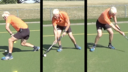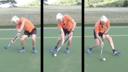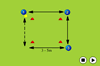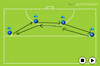
Field Hockey: receiving the ball on the move

August 2026

If you run a team at the youngest end of the grassroots pathway, this is the season the game around you changes shape. The FA's FutureFit framework, built off a two-year consultation and research with Liverpool John Moores University across hundreds of grassroots games, introduces a 3v3 entry format at Under-7s from 2026/27.

The instinct for a lot of coaches is to worry that smaller numbers mean a lesser game. The research points the other way. Fewer players means more touches, more one-against-one moments and far less standing about, which is exactly what a six or seven year old needs from their first experience of organised football.

What Actually Changes

The headline is the format itself: three players a side at Under-7s, as the entry point to the pathway, before players step up into the larger formats already familiar to you. Everything downstream of that is a consequence of the numbers.

With three a side, a player is never more than a pass away from the ball. The pitch is small enough that every player is in the game in every phase, and there is nowhere to hide, which is a feature rather than a problem at this age. The old sight of two full-backs picking daisies at the far end simply cannot happen.

Why Smaller Numbers Develop Better Players

Touches are the currency of development at this age. In an eleven-a-side game a young player might get thirty or forty touches in an hour. In a three-a-side game they can get that in ten minutes, and every one of them comes with a decision attached.

Small numbers also compress the game's problems into something a young brain can actually solve. A player learns to recognise when to dribble and when to pass because the picture in front of them is simple enough to read. Scale that picture up too early and they stop reading it at all, and just kick the ball forward and chase.

There is an enjoyment argument too, and it matters more than coaches sometimes admit. Children who touch the ball a lot come back next week. Children who spend an hour watching from the halfway line do not.

How to Coach the 3v3 Game

Step One: Let them play first. Resist the urge to organise a three-a-side game into positions. The whole point of the format is that everyone attacks and everyone defends, and the roles emerge naturally through the game rather than through your instructions.

Step Two: Coach in the gaps, not over the top. Short, quiet interventions with individuals between rotations beat stopping the whole game. If a game is flowing and every child is involved, the best coaching decision is usually to say nothing.

Step Three: Build your sessions in the same shape as the game. If matchday is 3v3, then your Tuesday night should mostly be threes and small conditioned games, not queues and cones. Practice that looks like the game transfers to the game.

Step Four: Rotate constantly. Small teams tire quickly and the intensity is genuinely high, so plan for short, sharp games with regular changes rather than one long session.

Step Five: Talk to your parents early. Some will arrive expecting the format their older child played. A short explanation at the start of the season about touches, involvement and enjoyment saves a lot of touchline confusion in September.

The Session Shape That Fits

A good Under-7s session under this framework barely looks like a training session at all. Arrival activity with a ball each, a small game to get them moving, then a series of threes and fours with different conditions, then more games. No lines, no laps, no waiting.

Conditions are your coaching tool. Want more passing? Add a second ball or a target gate. Want more dribbling? Reward beating a player. The condition does the teaching, and the children do not feel lectured.

Key Coaching Points

  • The 3v3 entry format at Under-7s is about touches and involvement, not a watered-down game.
  • Do not impose positions on a three-a-side team; let the roles emerge through play.
  • Match your training shape to your matchday shape, so practice transfers directly.
  • Use conditions and constraints to coach, rather than stopping the game to talk.
  • Plan short games with frequent rotations, as the intensity of small numbers is high.
  • Brief parents on why the format changed before the first game of the season.

Recommended Drills

VIEW ALL FOOTBALL GAMES

Frequently Asked Questions

Does 3v3 mean my players will struggle when they move up a format?

No, and the research behind the framework suggests the opposite. Players arriving from a high-touch, decision-rich format tend to be more comfortable on the ball and better at reading simple pictures, which is exactly what they need when the numbers increase.

How do I keep a 3v3 game competitive when one team is stronger?

Adjust with conditions rather than by moving children between teams every five minutes. Give the weaker side an extra goal to attack, or limit the stronger side's touches. The game stays close and nobody feels singled out.

What do I do with a squad of ten at Under-7s?

Run two or three small games side by side rather than one big one. It is more work to set up but it keeps every child playing, and it mirrors the matchday format they will experience.

receiving the ball on the move DRILLS
View All
Unfortunately there were no results for your search! Please try again
receiving the ball on the move ANSWERS
View All

Hi. I need to coach the following in a session%3A Attacking?

Hi. I need to coach the following in a session%3A Attacking unit play using right hand side of the pitch. Emphasis on ‘Posting up.’ Use of lead runs and receiving the ball on the move. Any ideas?

Danielle Mugridge Coach, England

Right-Wing Position

My daughter plays U13 hockey in the position of right wing.She gets different advice from her school coach and her club coach.I want to make sure that she is getting the right advice as she is passionate about her hockey. Firstly, exactly what is the full function of a right wing at this level of hockey (she will be going to U15 club hockey and U14 school hockey next season) She has a good understanding of the game and appears to me to read it well (I only played school level many years ago and things change) When her team is in the offensive position in the “D” she mostly waits at goal post to deflect ball into goal.  She appears to not be involved.  Comments from spectators have been made as to why she just stands there. There is a very skilled player in her team who hits the ball EXTREMELY hard.  I believe that at this level of hockey these extremely hard hits/passes do not achieve anything, they just keep going out. However, please can you advise on how to stop and control these very hard passes (that is if one can get to them) in order to move on with the game. Lastly, can you send some drills/exercises to get her eye in as well as positioning her body correctly for goal shooting.  The “hard hitter” and my daughter seem to be the main goal shooters of the team. Many thanks Lynne
Archived User Coach

How to improve the ball transfer from midfield to forwards?

Dear colleagues, I am coaching a 1st women team (Argentina) and the system that is working for us very well is 3-1-3-3. Given the quality players we've got in the midfield and attack we try to emphasize our offensive game all the time. The problem I am struggling to resolve is that the forwards do not get involved in chances to score inside the circle very often. The few chances the forwards have they are able to score but it is our midfielders who most of the time get to the circle in possession with the ball. I would like to see a quick transfer of the ball from the midfielders to the forwards who need to be in touch with the ball more often during the game and have the midfielders supporting the attack rather than being the leaders of the attack.Is there any drill or way to improve this aspect of the game? Thanks for your time. Martin

Martin Vila-Aiub Coach, Argentina

5-yard rule in hockey?

could someone comment on the 5 yard rule when entering the scoring area? There always seams to be a lot of wrong information regarding this rule.

Gaby Coach, United States of America

Typical session for Juniors

Why wont this session open for me when i log in its not there ??

Onny Gajadhar Coach, New Zealand

adding goal keepers to club training

Whats the best way to use keepers in a 2 hour club night .? Core skills of out field players needs more work to get them up to speed . Any ideas would be great ta Dave .

Dave Brierley Coach, England

Receiving the ball forward facing

Anybody any ideas on a conditioned game to encourage receiving the ball in a forward facing position?

Mark Stuart-Thompson Coach, England

U7 resources

Hi there. I'm looking for fun exciting resources for 7-year olds and below. Any assistance would be greatly appreciated.

Jason Minnaar Coach, Zimbabwe

Right-Wing Position | Sportpla...

My daughter plays U13 hockey in the position of right wing.She gets different advice from her school coach and her club coach.I want to make sure that she is getting the right advice as she is passionate about her hockey. Firstly, exactly what is the full function of a right wing at this level of hockey (she will be going to U15 club hockey and U14 school hockey next season) She has a good understanding of the game and appears to me to read it well (I only played school level many years ago and things change) When her team is in the offensive position in the “D” she mostly waits at goal post to deflect ball into goal.  She appears to not be involved.  Comments from spectators have been made as to why she just stands there. There is a very skilled player in her team who hits the ball EXTREMELY hard.  I believe that at this level of hockey these extremely hard hits/passes do not achieve anything, they just keep going out. However, please can you advise on how to stop and control these very hard passes (that is if one can get to them) in order to move on with the game. Lastly, can you send some drills/exercises to get her eye in as well as positioning her body correctly for goal shooting.  The “hard hitter” and my daughter seem to be the main goal shooters of the team. Many thanks Lynne

Archived User Coach

JOIN SPORTPLAN FOR FREE

  • search our library of 500+ football drills
  • create your own professional coaching plans
  • or access our tried and tested plans

Sportplan App

Give it a try - it's better in the app

YOUR SESSION IS STARTING SOON... Join the worlds largest hockey coaching resource for 1000+ drills and pro tools to make coaching easy.
LET'S DO IT