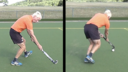
Field Hockey: reverse stick

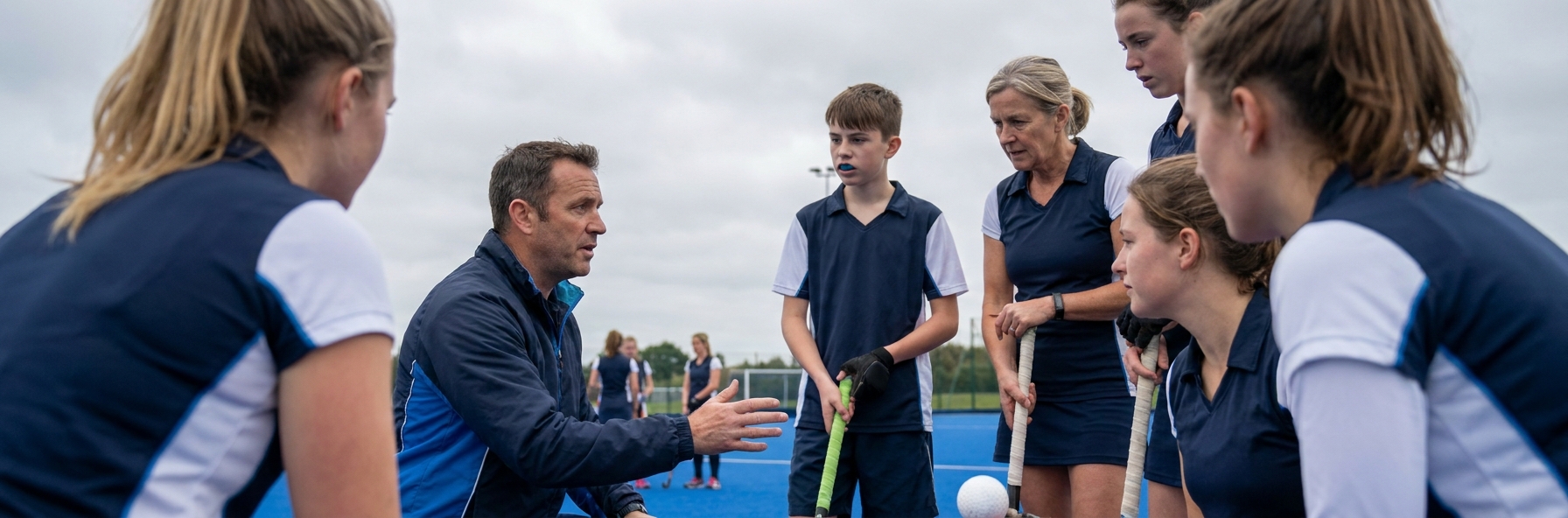
Connection-Based Coaching has emerged as a significant movement in hockey coaching. The core idea is simple but powerful: the relationship between coach and player is the foundation upon which all development is built. Without trust, without genuine connection, coaching effectiveness is limited.
This isn't soft philosophy. Research consistently shows that athletes who feel psychologically safe, who trust their coach, who believe their coach genuinely cares about them, perform better and develop faster.

What is Psychological Safety?

Psychological safety is the belief that you can take risks without being punished or humiliated. In a hockey context, it means players who feel safe to:
  • Try new skills without fear of criticism for failure
  • Ask questions without being made to feel stupid
  • Offer ideas without being dismissed
  • Make mistakes in matches without losing their place
  • Express concerns without negative consequences

When psychological safety exists, players are more creative, more willing to stretch themselves, and more honest about their development needs.

Building Connection

Know Your Players

Do you know what motivates each player? Their life outside hockey? Their hopes and concerns? Connection requires knowledge, and knowledge requires investment in getting to know people.

This doesn't mean becoming best friends. It means showing genuine interest, remembering what players tell you, and demonstrating that you see them as people, not just performers.

Listen More Than You Speak

Many coaches do too much telling. Connection-based coaching emphasises listening. When players speak, give them full attention. Ask follow-up questions. Reflect back what you've heard to show understanding.

Listening builds trust because it demonstrates respect. When players feel heard, they're more receptive to coaching.

Consistency and Reliability

Trust is built through consistent behaviour over time. If you say you'll do something, do it. If you have standards, apply them equally to everyone. Inconsistency destroys trust faster than almost anything else.

Appropriate Vulnerability

Coaches who admit mistakes, acknowledge what they don't know, and share their own development journey build stronger connections than those who project infallibility. Appropriate vulnerability models the openness you want from players.

Connection in Practice

Individual Check-Ins

Brief one-to-one conversations build connection over time. Not always about hockey - sometimes just "How are you?" delivered with genuine interest. These small interactions accumulate into strong relationships.

Personalised Feedback

Generic feedback shows you're not paying attention. Specific, personalised feedback shows you see the individual. "Good work" is less powerful than "I noticed you recovered really quickly after that turnover - that's the response we need."

Celebrating Progress

Connection-based coaches celebrate development, not just outcomes. The player who improves from poor to average has achieved as much as the player who was always excellent. Recognition should reflect effort and progress.

Managing Difficult Conversations

Strong connections make difficult conversations possible. When players trust you, they can hear hard truths. When they don't, the same truths are rejected as unfair criticism. Build the connection first; the honest feedback can follow.

Team-Level Application

Connection isn't just coach-to-player. Teams with strong player-to-player connections perform better. The coach's role includes creating conditions for these connections:

  • Team-building activities that build genuine relationships
  • Training structures that encourage collaboration
  • Addressing behaviours that damage team connection
  • Celebrating collective achievements

Common Barriers

"I don't have time": Connection doesn't require separate time - it's embedded in how you do everything. A two-minute conversation while setting up equipment still counts.

"It's soft": The evidence says otherwise. High-performance environments increasingly recognise that connection underpins performance, not detracts from it.

"Not all players want it": Different players need different levels and types of connection. Read what each individual needs and adjust accordingly.

Key Coaching Points

  • Psychological safety enables risk-taking and growth
  • Know your players as people, not just performers
  • Listen more, tell less
  • Be consistent and reliable
  • Personalise your interactions and feedback
  • Create conditions for player-to-player connection

Drills That Build Team Connection

VIEW ALL SMALL-SIDED GAMES

JOIN SPORTPLAN FOR FREE

  • search our library of 1000+ hockey drills
  • create your own professional coaching plans
  • or access our tried and tested plans
reverse stick DRILLS
View All
Unfortunately there were no results for your search! Please try again
reverse stick ANSWERS
View All

Penalty corner plays for offense, any suggestions?

Penalty corner plays for offense, any suggestions?

Taryn Dinella Coach, United States of America

My hockey team is still playing on uneven fields
My U19 boys hockey team is still playing on very uneven bumpy grass fields. What are the best ball stopping technique and drills
Archived User Coach

HELP! When i have the ball, am moving quicly and a defender comes, i cant' get past them, and i can't recover fast enough

Whenever i have the ball, and i'm moving up the field, everytime a defender comes and tries to take the ball, they always succed. This is a big problem of mine, i almost always lose the ball to a defender when i'm moving, and i usually can't recover (not that i literallyy CAN'T, the defender is just to far past me to be able for me to get the ball back)and get back the ball, and i feel really dumb because i'm a very talented player, but i'm alwayse afraid to take the ball mainly just because when i move fast and a defender comes, i try to lift the ball and it just doesn't work, and i normally can't pull the ball far enough either cause the grass is thik. PLEASSEEE help me adn give me some advice on recovering and better techniques on how to get by a defender while moving very quickly.

Archived User Coach

How can a defender defend against a reverse stick hit?

How can a defender defend against a reverse stick hit on goal?

Archived User Coach

how do i do a really good reverse hit?!

how do i do a really good reverse hit?!

Coach, Scotland

How do you teach a tomahawk hit?

How do you teach a tomahawk hit?

Joe Hill Coach, Australia

How to do an Indian dribble in hockey?

how to do a indian dribble in hockey

Archived User Coach

1st ever training Session Structure?

I have been given my first team ever!! They are 11 year old girls and I wanted guide/ recommendation on how I should structure my one hour sessions? E.g. how long should I spend on a warm up, drill etc. .Cheers,Freya

Archived User Coach

Progressive Practices for a Hit?

I'm doing A Level PE and I need to coach a player on a weakness of theirs and I need a few progressive practices I could use for a Hit other than the basic technique. It needs to eventually lead to them correctly and consistently performing the hit. Thanks

Archived User Coach

Coaching plan (season outline) for coming season?

Hi all, after "volunteering" at the last minute to coach last season, I'm looking forward to coaching again this season but would like to be a bit more organised starting the season. Last season I used drills from here (thank you contributors) and put together a practice plan each week addressing what I thought were our weakness from the game just played. This got us through the season, we were promoted after grading and finished the season in the top 4 playoffs for our grade.I wonder if there is some kind of guide to putting a more coherent training plan together for the season.I'm coaching a boys secondary school team, aged 12-18. What kind of skills should they have mastered?What should they be attempting, working towards mastering (individually and as a team)?I last played as a collage boy on grass fields, the change to turf pitches has obviously obsoleted (along with age) much of what I knew as a player.Any pointers appreciated.David

David Smith Coach, New Zealand

How to trap penalty corners like the Spanish?

I wanted to learn how to trap pc's like the the Spanish team i.e with the stick upright. Does any have any tips?

Archived User Coach

How do you hit a reverse stick shot/pass?

In field hockey, how do you hit a tomahawk flat and accurately?

sarah taylor Coach, Northern Ireland

Striking ball on the reverse side

My players never seem to be able to execute a successful reverse stick shot when in the D. What are the key coaching points/technique for this skill that I should be highlighting to them?

Paul Furlong Coach, England

how to tackle

tackle how to approach the person in control of the ball

Shirley Perkins Coach, United Kingdom

Goal shooting

Can I please have drills to help with shooting goals? We actually play on grass fields (u/13A girls)

Annelie Smith Coach, South Africa

low back hand reverse hit

lowback hand reverse hit definition

?????????? Coach, United States of America

How do you hit a reverse stick...

In field hockey, how do you hit a tomahawk flat and accurately?

sarah taylor Coach, Northern Ireland

JOIN SPORTPLAN FOR FREE

  • search our library of 1000+ hockey drills
  • create your own professional coaching plans
  • or access our tried and tested plans

Sportplan App

Give it a try - it's better in the app

YOUR SESSION IS STARTING SOON... Join the worlds largest hockey coaching resource for 1000+ drills and pro tools to make coaching easy.
LET'S DO IT