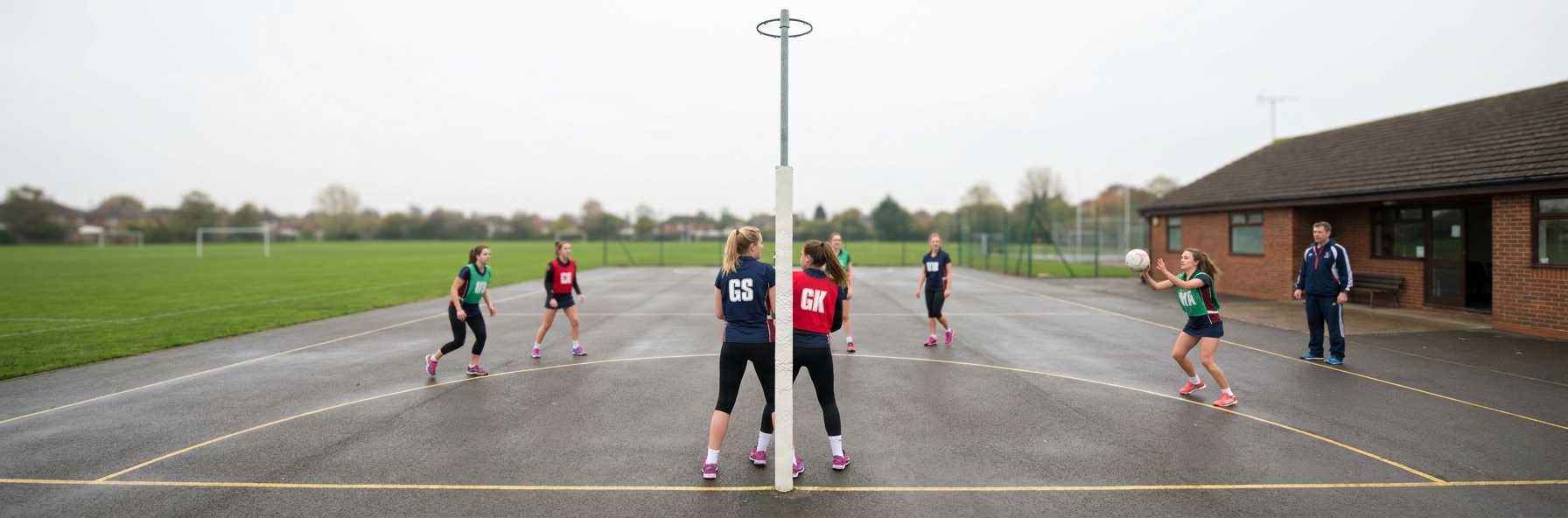
Netball: back line passes

August 2026

Ask a club coach what their defensive system is and the answer is almost always the same: mark your player, work hard, get a hand over. That is a perfectly good default. The problem comes when it is the only thing a team knows, because some opponents are simply better at one-on-one than you are.

A zone changes the question. Instead of asking your defenders to win individual contests they might lose, it asks them to protect space and force the ball into areas you want it to go. Against a team with a dominant attacking pairing, or one that lives on quick front-cut feeds, it can turn a game.

When a Zone Is the Right Call

Use a zone when you are being beaten individually rather than collectively. If your goal defence is losing a physical battle every centre pass, moving to a zone stops that contest from deciding the game.

It also works well against a side that moves the ball fast down one channel, or one that relies on a single feeder. A zone congests the space in front of the circle and forces the ball wide or backwards, which slows everything down.

Equally, know when not to. Against a patient team with good long passing and a shooter comfortable at distance, a zone can simply hand them time and space. A zone is a tactical choice, not a hiding place.

The Principles That Make It Work

A zone is not standing still. Every player has an area of responsibility, but the whole shape slides together as the ball moves. If one defender chases and the others do not adjust, the zone has a hole in it and the ball goes straight through.

Communication is the difference between a zone and a mess. Players have to call the ball's position, call handovers as an attacker moves from one area to another, and call when the shape needs to compress or expand.

The hands matter more than the feet. In a zone, defenders are often a metre or two off their player rather than tight to them, so pressure has to come from arms over passing lanes rather than from body contact.

Building It in Training

Step One: Start without attackers. Walk the shape through, ball in hand, moving the ball around the court so players feel how far and how fast the whole unit slides.

Step Two: Add passive attackers. Let the attacking side move the ball but not attack the space, so defenders can practise the slide and the handovers without panic.

Step Three: Name the trigger. Decide as a squad when the zone goes on, whether that is from a centre pass, after a goal, or on a call from the captain, and rehearse the switch itself.

Step Four: Coach the handover. The moment an attacker crosses from one defender's area to another is where zones break down. Drill that specific moment on its own.

Step Five: Play it live and lose a few. A zone will leak goals while it is being learned. Give it a full quarter in a practice match rather than abandoning it after two possessions.

Key Coaching Points

  • Use a zone when you are losing individual contests, not as a general default.
  • The whole shape slides together; one player chasing the ball breaks the system.
  • Constant communication about ball position and handovers is non-negotiable.
  • Pressure comes from hands over passing lanes rather than close body contact.
  • Rehearse the switch into the zone as its own skill, with an agreed trigger.
  • Give it time in practice matches, because a new zone always leaks before it holds.

Recommended Drills

VIEW ALL ZONE DEFENCE DRILLS

Frequently Asked Questions

Is a zone legal in netball given the obstruction rule?

Yes. Defenders in a zone are usually further from their opponent than in one-on-one marking, which if anything makes the three-foot distance easier to respect. The rule to watch is defenders drifting in to contest without re-establishing distance.

What age can players start learning a zone?

Once players reliably understand their own position and can communicate under pressure, which for most is around the upper junior age groups. Below that, one-on-one defending teaches the individual skills a zone later depends on, so there is no rush.

How do we switch out of a zone if it is not working?

Have an agreed call and practise it. Switching systems mid-game is a skill in itself, and a team that has only ever rehearsed going into a zone will get caught halfway between two systems when they try to come out of it.

back line passes DRILLS
View All
Unfortunately there were no results for your search! Please try again
back line passes ANSWERS
View All

What drills could I use to improve my teams back line?

What drills could I use to improve my teams back line passes?

Archived User Coach

How do I teach my team to pass and then move quickly?

How do I teach my team to pass and then move quickly so that the opposition's defenders cannot intercept our passes.

MC Coach, New Zealand

How do we get taller girls to jump?

How do we get taller girls to jump?

Eddie Janmaat Coach, Australia

Court systems?

Can someone please advise me on where can I locate sound information on court systems?  Thanks.  Wendy

Archived User Coach

How do I teach my team to read the play?

I coach a team of U15 girls who vary in their ability. Our play from the baseline throw in is disjointed and the ball is often intercepted as a result. What is the best way to teach the girls to read each others play and operate as a smooth unit?

Danielle Bridgette Schoer Coach, Australia

Help with workshop for U11-U13...

need help with a workshop/clinic (warm-up ect)

Archived User Coach

Contact ruling and short passes.

Now please correct me if Im wrong, but I played a game of netball today, and there was so much contact and obstruction that was not being picked up. Both teams were complaining about it, and when we asked the umpire why none of it was being picked up, she replied, that its only contact if you have complete possession of the ball. So basically if you do not have the ball you can push your player out the way and that isn't contact (by this state umpire....apparently) we were absolutely floored and were having a huge laugh at this. Is this what netball is coming to? I have never heard this before and would love for some opinions if i have completely got contact and obstruction wrong. Secondly, I have recently taught my U11s shooters to pass around the goal post for a back line throw in. My question is, what constitutes a short pass in this instance, as they apparently (I was on the opposite side of the court) didn't have much between their hands when they passed, but didn't get called and the umpire was right there. GF is this weekend and would hate for them to do it and get called, so just wanted to get some clarification from some of the umpiring gurus on here.

Lee-annes Netball Coach, Australia

Where should GS stand during oppositions Centre Pass?

I was watching the silver ferns game last night & noticed the GS stands right up on the line when the opposing team is having their centre pass. Just wondering opinions on that, do you think its to put pressure on WD/GD if the centre passes back, or I guess she is there if there is any mistake made (loose ball possibility). I am just wondering if I try this with my 10/11 year olds. My GS wants more work to do!!!

Rachel Coach, New Zealand

mrn can you pliz help me with this question,

Describe the appropriate trainning programmes for physical fitness improvements in netball

Archived User Coach

Hunger for the ball!! Killer Instinct

HI,I would like some ideas on how I can get my under 12's representative team hungry for the ball? They need to become more aggressive without being bitchy if you know what I mean.Thanks Leah

Archived User Coach

U10's making space and passing the ball early?

Hello all, I have been coaching my u10's currently for 2 years now. They are a fabulous little team i.e. gs holds and defence box out etc however we are never winning games! They are currently playing up a year and after sitting back and watching what is going wrong I had noticed they all seem to be in one area so no-one can drive into a space to receive a direct fast ball. When this occasionally does happen the ball is not released fast enough and consequently intercepted! I was wondering if anyone has an tips on space, driving into space, and early passes! This team could be amazing if we sort this is out! Please help!!!!!!!!!

Mia Kersey Coach, England

Drills for channels

I'm having trouble getting my girls to stay on there side, even after a few drills it's not sinking in Asked using Sportplan on Mobile

Kerrie little Coach, Australia

Stepping on transverse lines

Good day. I would like some clarity regarding transverse lines. Are players allowed or how far are players allowed to step on or stand on transverse lines during play or at goal circles and at centre passes. Please some controversy regarding this rule.

Rene October Coach, South Africa

what is a compositional piece in netball

what would you create or arrange eg planned situations

gerda wilson Coach, Northern Ireland

Goal Defence defending shooter tips

Hello - i am looking for a few GD tips on the best way to defend a shooter that receives the ball a couple of ways as i always struggle to get around them when they do these moves! First way is that the shooter lunges out very wide (practically doing the splits) to receive the ball from the feeder on the circle edge and steps back closer to the net with the foot that is closest. I can defend her getting close to the net, but then she turns to the feeder and jumps and splits - thus always ending up close to the net. The second way is when the shooter stays quite stationery under the net, a couple of foot off the back line and holds her space there. she receives the ball by a large over head pass, so she steps back slightly on one leg to receive the ball from the feeder. what would be the best way to defend all the large overhead long passes to her, or draw her out? any help or some ideas i can try would be great! thank you :-)

paula xox Coach, England

turning fully

drills for turning fully

0273623034 Coach, New Zealand

Attacking backline pass off th...

HiCan a shooter rebound the ball( from a backline throw in) off the post and jump onto court, catch the ball from the post rebound and then shoot? It seems crazy to me but I have been told that this is now allowed?

Sue Kersey Coach, England

If the ball rebounds off the p...

If a player is taking a back line pass and her pass hits the goal post, can she catch the rebound on court?

Archived User Coach

Can youplay ball off post from...

Playing ball off post from back line pass

karen channon Coach, England

Contact ruling and short passe...

Now please correct me if Im wrong, but I played a game of netball today, and there was so much contact and obstruction that was not being picked up. Both teams were complaining about it, and when we asked the umpire why none of it was being picked up, she replied, that its only contact if you have complete possession of the ball. So basically if you do not have the ball you can push your player out the way and that isn't contact (by this state umpire....apparently) we were absolutely floored and were having a huge laugh at this. Is this what netball is coming to? I have never heard this before and would love for some opinions if i have completely got contact and obstruction wrong. Secondly, I have recently taught my U11s shooters to pass around the goal post for a back line throw in. My question is, what constitutes a short pass in this instance, as they apparently (I was on the opposite side of the court) didn't have much between their hands when they passed, but didn't get called and the umpire was right there. GF is this weekend and would hate for them to do it and get called, so just wanted to get some clarification from some of the umpiring gurus on here.

Lee-annes Netball Coach, Australia

JOIN SPORTPLAN FOR FREE

  • search our library of 700+ netball drills
  • create your own professional coaching plans
  • or access our tried and tested plans

Sportplan App

Give it a try - it's better in the app

YOUR SESSION IS STARTING SOON... Join the worlds largest netball coaching resource for 700+ drills and pro tools to make coaching easy.
LET'S DO IT