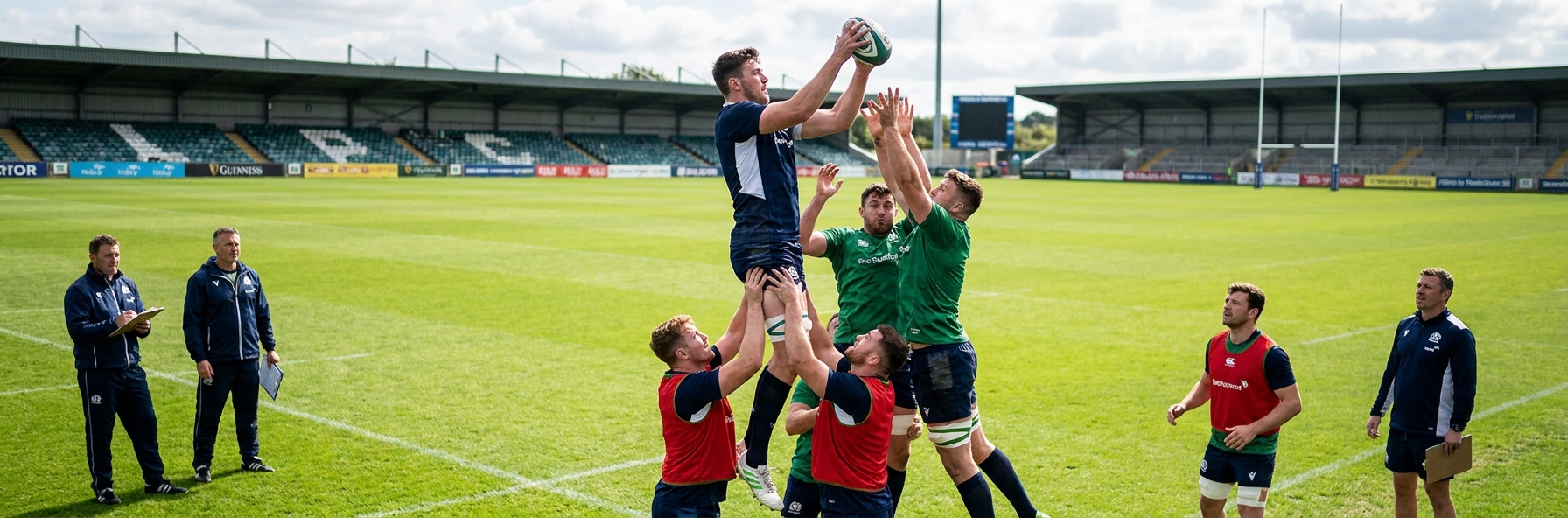
Community | Field based conditioning and movement training

The 50:22 law, introduced as a trial and now a permanent fixture, has fundamentally changed how teams approach tactical kicking. A kick from your own half that bounces in-field, crosses the 22, and finds touch rewards the kicking team with the lineout throw-in. This single law change has altered both attacking and defensive strategies across the game.

Understanding the Law

The requirements:

  • Kick must originate from behind your own 10-metre line
  • Ball must bounce in the field of play (not direct to touch)
  • Ball must cross the opposition's 22-metre line
  • Ball must then go into touch
  • Kicking team retains the throw at the lineout

These requirements create specific technical demands. The kick must be long enough to reach the 22, accurate enough to hit the corner, and struck correctly to bounce in-field first.

Why 50:22 Matters

Before the 50:22, kicking from your own half that went to touch gave the throw to the opposition. The only benefit was territorial gain. Now, an accurate 50:22 delivers both territory AND possession - a game-changing combination.

The tactical impact:

  • Lineout attacking platform in the opposition 22
  • Defensive scramble if full-back fails to cover
  • Forces back three to position wider, creating space elsewhere
  • Punishes lazy defensive positioning

Executing the 50:22

The Grubber Option

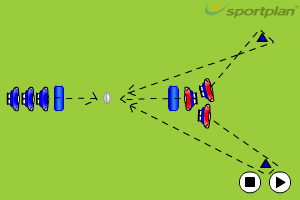
A well-struck grubber can beat the full-back to the corner. The low trajectory keeps the ball in play, and end-over-end rotation makes the bounce predictable.

Grubber technique:

  • Strike through the middle of the ball, toe down
  • Generate end-over-end spin for predictable bounce
  • Aim for the gap between full-back and touchline
  • Follow up - if it doesn't reach touch, contest the chase

The Chip and Chase

A chip kick over the defensive line that bounces in the 22 and reaches touch. Higher risk - defenders can field it before it reaches touch - but effective against narrow defences.

Chip technique:

  • Get under the ball with angled foot
  • Enough height to clear defenders, not so much that chase time is lost
  • Backspin for controlled bounce toward touchline

The Cross-Field Kick

Against a defence shifted to one side, the cross-field kick to the far corner can find space. This is a longer kick requiring more accuracy but exploits defensive imbalance.

Defensive Adjustments

The 50:22 has forced defensive positioning changes. Full-backs can no longer sit narrow - they must cover the width. Wings must be aware of their touchline responsibilities.

Defending against 50:22:

  • Full-back positions wider to cover both corners
  • Wings drop deeper to provide secondary cover
  • Communication about kick threats: "Watch grubber!"
  • Quick identification and reaction to kicks

These defensive adjustments create space elsewhere. If the full-back is wide, the central channel opens. If wings drop deep, the defensive line loses numbers.

When to Attempt 50:22

Good opportunities:

  • Full-back positioned narrow or deep
  • Wide channel space visible
  • Defence rushed up, leaving back field exposed
  • Slow ball where running attack is risky

Poor opportunities:

  • Full-back already covering the corner
  • Quick ball with attacking momentum
  • Wind against making accurate kicking difficult
  • Kicker not in optimal position

Training 50:22 Execution

Individual kicking practice:

  • Set targets at the corner - grubber to specific zones
  • Practice both feet (advantage when on either side)
  • Vary distances - not every 50:22 opportunity is from the same position

Team practice:

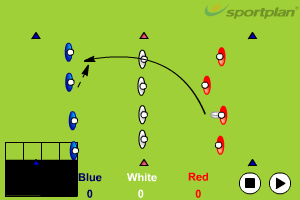
  • Live scenarios with defence - read the full-back position
  • Decision-making: kick, run, or pass?
  • Chase organisation when the kick doesn't reach touch

Alternative Outcomes

Not every 50:22 attempt succeeds. But the threat creates secondary benefits:

If fielded before touch: You've still gained territory and forced the opposition to start from deep. Apply chase pressure and compete for their exit kick.

If it bounces out before 22: Opposition throw, but you've gained significant ground. Reset defensive line.

If full-back covers: Your threat has pulled them wide. Subsequent attacks may find more space centrally.

The Mental Game

The 50:22 threat changes how oppositions defend, even when you don't kick. Simply having players capable of executing the kick forces wider positioning and changes defensive dynamics.

Make sure your opposition knows you have this weapon. Execute it successfully early in matches, and they'll respect the threat throughout.

Key Coaching Points

  • The 50:22 rewards accurate kicking with possession AND territory
  • Grubbers are highest percentage - practise them
  • Read the full-back position before deciding
  • Even unsuccessful attempts gain territory
  • The threat changes defensive positioning

Drills to Master the 50:22

VIEW ALL KICKING DRILLS

JOIN SPORTPLAN FOR FREE

  • search our library of 1100+ rugby drills
  • create your own professional coaching plans
  • or access our tried and tested plans
Paul Joyce Coach, England

DESCRIPTION

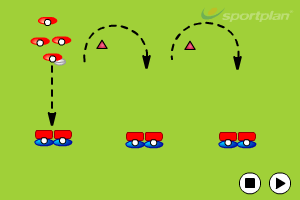
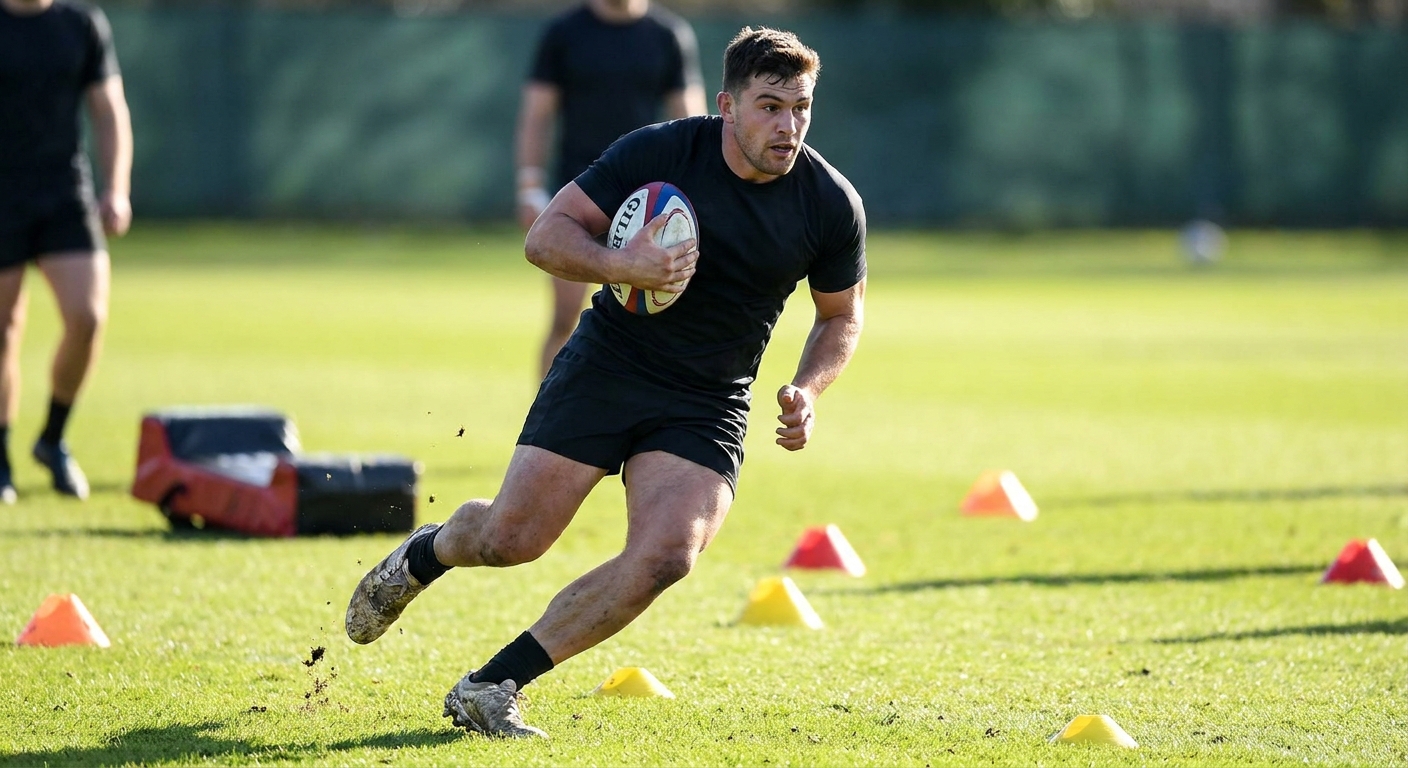
Set up for 6 easy to use drills to improve Aerobic capacity, Anaerobic endurance and change of direction skills at speed.

COACHING POINTS

In and out runs Aim: Improve ability to change direction without loss of speed/acceleration. Set up: Place cones in a 5x3 grid with 5m distance in between each. Performance: Using one line of five cones; use an effective running action to run in and out of each cone to the end. At each cone increase speed until at maximum speed upon reaching the final section and maintains until the end of the course. Coaching points: Athlete must maintain an upright posture or a slight forward lean. The athlete must be coached to not allow the hips to sink on contact. The inside foot will contact the ground directly in-line with the centre of mass or slightly across the centre line creating a small ‘crossover step’. Foot contacts should be on the balls of the feet. Eyes should be looking forward, not down at feet. Curve runs Aim: Improve ability to change direction without loss of speed. Set up: Place cones in a 5x3 grid with 5m distance in between each. Performance: Using all fifteen cones; start on one corner and complete a single arced run around either the middle cone of the middle line or middle cone of furthest line and finishing at the end cone of the line you began on. This should be performed whilst athlete is continuously accelerating up to top speed. Once athlete has completed desired number of repetitions from one side, they must repeat from the opposite side. Coaching points: Athlete must maintain an upright posture or a slight forward lean. The athlete must be coached to not allow the hips to sink on contact. The inside foot will contact the ground slightly across the centre line and under the centre of mass creating a small ‘crossover step’. Foot contacts should be on the balls of the feet. Eyes should be looking forward, not down at feet. Cut step runs Aim: Develop and improve and athletes ability to change direction when a rapid deceleration and then acceleration is required, using a ‘cut step’. Set up: Place cones in a 5x3 grid with 5m distance in between each. Performance: The athlete begins the drill at one of the bottom corners. The athlete accelerates towards the middle cone on the next line up, at which point they will aggressively decelerate and perform a cut step and head back out towards the outside cone on the third row. The athlete will repeat this action, zig-zagging, all the way to the other end of the course, performing a cut step at each cone. To change the angle of the cut step and distance for them to accelerate, have the athlete zig-zag between both outside line of cones. Note: This drill can be used with pairs or small groups. Have them start at opposite corners and stagger their starts to avoid collisions in the middle. Coaching points: The athlete must accelerate towards the first cone using good acceleration mechanics (centre of mass ahead of base of support, powerful leg drive with low recovery leg mechanics, aggressive arm drive, and running on the balls of the feet). As the athlete reaches the cone, the centre of mass should be lowered and stride should be shortened. When changing direction the cutting foot needs to be planted wider than the hips and knees. When changing direction the foot should be planted in a range that is in between pointing the direction you were moving, and the direction in which you wish to move, although the foot being at either of these extremes is sub-optimal and may increase the risk of ankle injury. (No two foot plants will ever be the same, so do not try to over coach this). When changing direction the foot should land almost flat footed, but with the weight towards the ball of the foot, which will allow for a greater force to be applied. The body weight should stay within the base of support, enabling an effective line of force to be maintained. The athlete should attain and maintain effective positive angles at the ankle knee and hip. The athlete should use an effective acceleration action. 150 Shuttle runs Aim: Improve speed endurance with multiple accelerations and decelerations. Set up: place two cones 25m apart or work from try line to 22m line. Performance: Complete six continuous shuttles (132m-150m) as fast as possible. Coaching points: Use good acceleration mechanics to begin drill (Centre of mass ahead of base of support, powerful leg drive, low recovery leg mechanics, aggressive arm drive, and running on the balls of feet). Use good linear top speed mechanics mid run. As the athlete reaches the cone, the centre of mass should be lowered and stride should be shortened. When changing direction, the hips need to be turned around 90o, and the cutting foot needs to be planted wider than the hips and knees. When changing direction, the foot should be planted in a range that is in between pointing the direction you were moving, and the direction in which you wish to move, although the foot being at either of these extremes is sub-optimal and may increase the risk of ankle injury. (No two-foot plants will ever be the same, so do not try to over coach this). When changing direction, the foot should land almost flat footed, but with the weight towards the ball of the foot, which will allow for a greater force to be applied. The body weight should stay within the base of support, enabling an effective line of force to be maintained. The athlete should attain and maintain effective positive angles at the ankle knee and hip. The athlete should use an effective acceleration action. Tempo runs Aim: Developing baseline sprint related conditioning. (Tempo runs are neither sprinting nor jogging). Set up: Open space to perform straight line runs. In this example, I am using half the length of a rugby pitch, although the distance is can be as much as 150m or as little as 30m (performing a shuttle tempo run). Performance: The athlete will stride the length of the course, walk back and repeat. A stride is the middle ground between jogging and sprinting. Have the athlete perform a set distance and only measure the runs, not the recovery walks. Coaching points: Be sure that the athlete is striding so that they are developing the full running mechanics (hip hyperextension) at a lower intensity than a full sprint would require. Incremental acceleration runs Aim: To develop acceleration speed in a controlled manner whilst minimising the risk of injury after an extended period away from performing/training. Set up: Set up five cones in a line, the first four being 5m apart from the previous. Place the fifth cone 15m beyond the fourth cone. The total distance from the first cone to the final cone should be 30m. Performance: The athlete starts at the first cone and accelerates to a designated cone. Once they reach that cone, they maintain the speed they have reached until they pass the final cone at which point they begin to slow down in a controlled manner. Coaching points: Use good acceleration mechanics to begin drill (Centre of mass ahead of base of support, powerful leg drive, low recovery leg mechanics, aggressive arm drive, and running on the balls of feet). Use good linear top speed mechanics once they reach the desired speed. Do not allow the athlete to stop suddenly once they reach the final cone, have them slow down in a controlled manner. References Jeffreys, I. (2010). Gamespeed: movement training for superior sports performance. Monterey: Coaches Choice Boyle, M. (2017). New Functional Training for sports 2nd Edition. ebook: Human Kinetics

This practice has no coaching points

PROGRESSION

This practice has no progressions

READ MORE
READ LESS

JOIN SPORTPLAN FOR FREE

  • search our library of 1100+ Rugby drills
  • create your own professional coaching plans
  • or access our tried and tested plans

JOIN SPORTPLAN FOR FREE

  • search our library of 1100+ rugby drills
  • create your own professional coaching plans
  • or access our tried and tested plans
;

Sportplan App

Give it a try - it's better in the app

X
YOUR SESSION IS STARTING SOON... Join the growing community of rugby coaches plus 1100+ drills and pro tools to make coaching easy.
LET'S DO IT