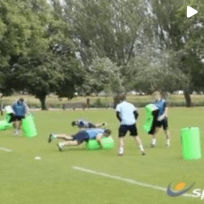
DESCRIPTION Divide the group into two teams. Members of the team that starts with the ball have to "tag" the opponents (touching them with the ball). Who has the ball cannot run but can pass to others team members. Players "tagged" have to freze and stay with both the arms forming a T. Players of the team without the ball can unfreze the tagged mate touching them. The team that tags all the opponents or most of them at the end of the time wins COACHING NOTES This warm up is usefull for start thinking the young players about how use the space. Is also a good exercise to develop single skills like passing and catching the ball. At least,for all the beginners is a good way to understand how important are teammates (you cannot move with the ball so you need to pass it to a mate in a better position to tag the opponent). NOTICE If the game is not working or number of tags is to low, reduce the dimension of the field.
This warm up is usefull for start thinking the young players about how use the space. Is also a good exercise to develop single skills like passing and catching the ball. At least,for all the beginners is a good way to understand how important are teammates (you cannot move with the ball so you need to pass it to a mate in a better position to tag the opponent). NOTICE If the game is not working or number of tags is to low, reduce the dimension of the field.
This practice has no coaching points
This practice has no progressions

in more ways than one
 sportplan_rugby



Greasy balls and soft pitches turn tidy handling into a lottery. Here is how to coach your players to keep hold of the ball when November conditions bite.

Most line breaks are made by support runners, not ball carriers. Teach the angles, depth and timing that get them there.

The isolated ball carrier is rugby's spookiest turnover. Here is the five-step fix, plus drills that rebuild support lines fast.