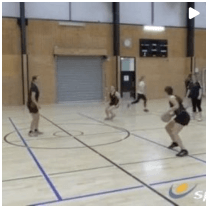
Practising staying ball side in defence as ball comes down the court, this can be used anywhere along the court, but very relevant for GK marking a GS. 2 other players work the ball down the court and the dending player should work feet around their attacker so that they can always see the attacking player and the ball. The ball can be released into the circle at any point they think the attacking player is available. To build confidence, start with the attacker being relatively static (like a holding GS), with defender working hard. Progressions: Intensity of the attacker can increase; defender looking to remain ballside all of the time. Add in another pair in the circle, both defenders looking to be ball side as it works it's way down the court (DADA) Take into other areas of the court for positional relevance.
Feet shoulder width apart Weight balanced, on balls of feet Arms flexed at front or side of body Head up Defender half covers attacking player Body slightly angled towards attacking player Within arms reach of attacking player Watch player and ball Small steps, no lunging Turning hips and feet to AVOID side stepping or back-pedalling - this will never be as quick a movement. As attacker starts adding in movement, avoid turning/following towards attacking player as you will lose sight of ball
This practice has no coaching points
This practice has no progressions

in more ways than one
 sportplan_netball


Fixtures are stacking up and legs are getting heavy. Here's how to manage training load through the winter block so your squad stays on court, not on the sidelines.
Quiet teams concede easy goals. Teach your players to call for the ball and talk through defence, and your combinations hold up when it matters.
A ready-to-run Halloween session for High 5 and junior netball. Real drills in spooky costume, with a warm-up, a technical block, a decision-making game and a finish.